If your child has Down syndrome, you have probably lived this scene: they understand the question perfectly, they know exactly what they want to say, and the words will not come out clearly enough for anyone outside the family to catch. For most children with Down syndrome, understanding runs years ahead of speaking. That gap is where the frustration lives, and it is exactly the gap AAC is built to close.
This guide covers why speech is so much harder than understanding in Down syndrome, how AAC (Augmentative and Alternative Communication) fits alongside the signing many families already use, and what to look for in an app.

Why Speech Lags Behind Understanding
Down syndrome affects speech through several routes at once: low muscle tone in the mouth and face, differences in mouth shape, frequent glue ear and hearing loss in the early years, and difficulty with the rapid motor sequencing that clear speech demands. None of that touches what your child knows or wants to say. It is a delivery problem, not a knowledge problem, and treating it that way changes everything about how you support them.
You Are Probably Already Using AAC
Most families of children with Down syndrome already sign, whether that is Makaton, Lámh, or a home-grown collection of gestures. Signing is AAC, and the research on it is one of the reasons we know augmentative communication supports speech in Down syndrome rather than delaying it: children who sign develop language faster, not slower. A speech-generating app is not a replacement for signing; it is the next layer. It speaks aloud to people who do not know the signs, it holds far more vocabulary than most families can sign, and it stays understandable when motor difficulties make signs imprecise.
Keep signing. Model the sign, say the word, and tap the symbol when you can. Every route into language reinforces the others, and your child will use whichever is fastest in the moment.
What AAC Gives a Child With Down Syndrome
- A voice strangers understand. Family members learn to decode approximations of words. The wider world does not. A clear spoken voice removes the interpreter.
- A model for speech practice. Every tap says the word cleanly and identically, giving your child a consistent target to imitate at their own pace.
- Vocabulary beyond requests. Comments, questions, feelings, and jokes, which are exactly the strengths of many children with Down syndrome, get buttons of their own.
- A bridge through the unintelligible years. Many children with Down syndrome speak more clearly as they grow. AAC keeps communication rich in the meantime, and nothing is lost when speech takes over.
Choosing an App: What Matters for Down Syndrome
- Visual-first learning. Visual memory is a relative strength in Down syndrome. Clear symbols with the written word on every button play directly to it, and the print exposure quietly supports reading.
- Buttons that never move. Fixed positions let your child learn where words live by feel, which matters when fine-motor precision is still developing.
- Adjustable grid size. Start with a handful of large targets and grow the grid as pointing gets more precise, without rebuilding the board.
- Real photos. Being able to put mom, the dog, and the actual favorite cup on buttons makes the board instantly meaningful.
- Patience built in. No timeouts, no penalties for slow responses, no reward noise that turns communication into a game.
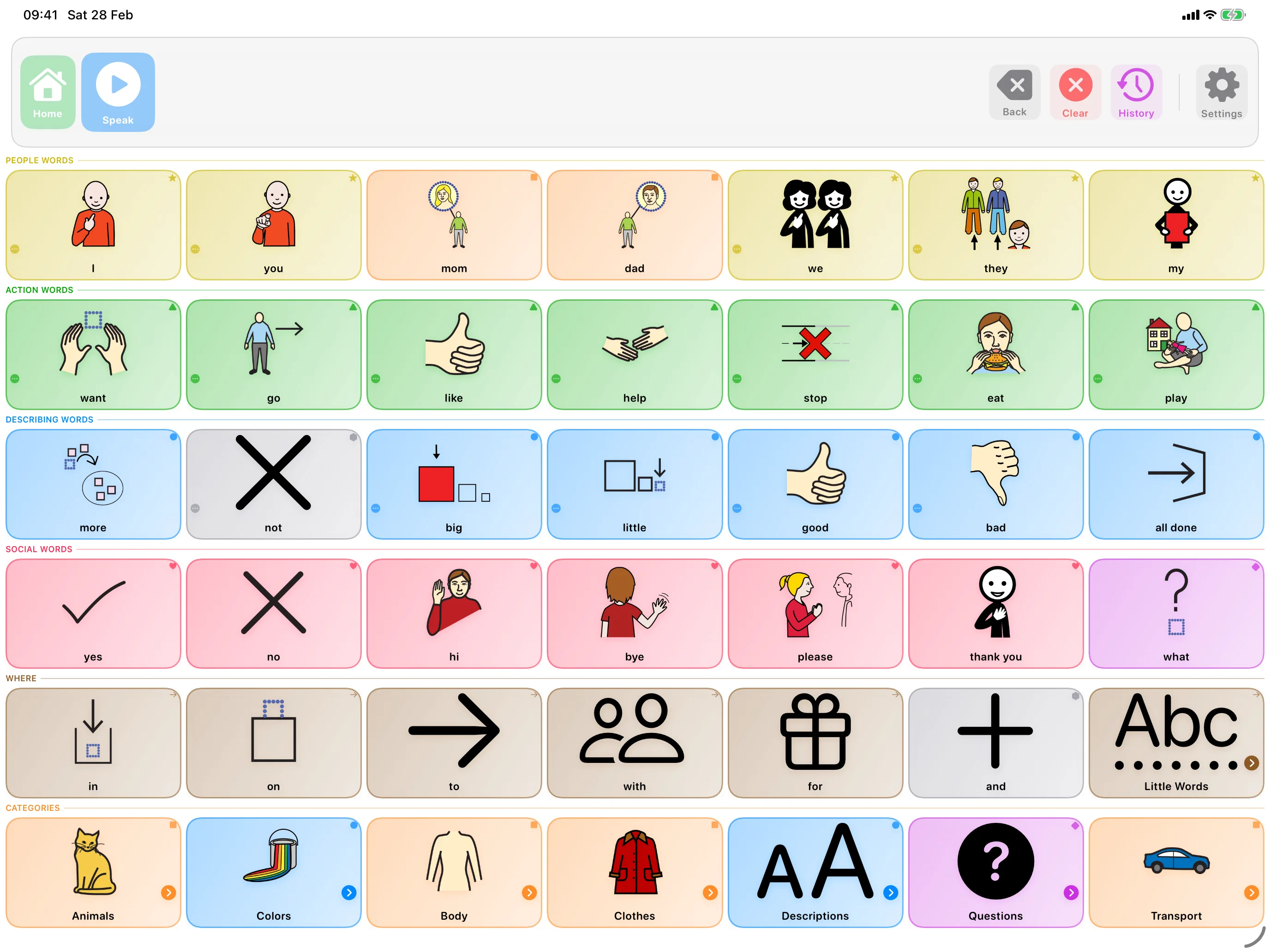
How SpeakPad Fits
SpeakPad was designed around exactly these needs: symbols never change position, every button shows its written word, the grid grows from a few large buttons to full boards as your child does, and you can add photos from your own camera roll in under a minute. Every tap speaks in a clear voice that doubles as a speech model. It is free to download, so you can start today and let your speech-language therapist shape the vocabulary as you go.
Getting Started
- Get hearing checked first. Glue ear comes and goes in Down syndrome, and language input depends on it. Keep audiology appointments even when things seem fine.
- Model without testing. Tap words as you speak during meals, play, and books. Your child learns the board by watching you use it.
- Keep signing alongside. Sign, say, and tap. Let your child pick the channel.
- Celebrate every message. A sign, a tap, a word approximation: respond to the meaning, not the method.
Related reading
- AAC for Children With Cerebral Palsy
- AAC for Gestalt Language Processors
- Moving From PECS to an AAC App
- Apps for Late Talkers: What Helps and What to Skip
- How to Lock an iPad to One App with Guided Access
- Will AAC Stop My Child From Talking?
- What Are Core Words? A Simple Guide to AAC Core Vocabulary
- AAC for Childhood Apraxia of Speech (CAS): A Parent's Guide
- Best Free AAC Apps for iPad in 2026
- How to Import AAC Boards from Other Apps (OBF & OBZ Explained)
- Best AAC Apps for Autism on iPad (Parent Guide)
- The Best AAC Apps for Toddlers with Speech Delays
- How to Introduce an AAC Device to a Non-Verbal Child
Close the Gap Between Knowing and Saying
Private, offline AAC for iPhone and iPad. Speaking is always free, with optional SpeakPad Pro tools for caregivers.
Learn More About SpeakPad