If your child's talking is built from borrowed lines, a film quote for excitement, "are you okay?" whenever anyone is sad, whole songs at bedtime, those lines are worth taking seriously. Repeated speech, called echolalia, was long dismissed as meaningless. Research with autistic children has found otherwise: echoed phrases often do a job, such as asking for something, protesting or sharing excitement.
"Gestalt language processing" is a popular way to describe these children: they are said to learn language in whole chunks first and only later break the chunks into single words. Many therapists and families use the idea, but it has little research behind it, and a 2024 review questioned how it is being applied. You do not need to settle that debate to set up a good board. This guide covers the advice that holds up either way.
What Is Gestalt Language Processing?
The framework says some children pick up whole strings, "let's get out of here!", tied to the feeling of the moment they heard them, and use the string to mean that feeling, then gradually break strings into words they can recombine. Research has not shown that children move through these set stages, or that they need a separate therapy approach. What is well established is narrower and more useful: many autistic children use echoed phrases to communicate, and adults who respond to what a phrase means help language grow.
Echolalia Is Communication
The scripts are not noise to be extinguished. A child who says "to infinity and beyond!" while flapping with joy is not stuck on Toy Story; they are telling you they are delighted, with the best tool they have. When you treat scripts as meaningful, you respond to what the child meant, and responding to meaning is how all language grows. The practical shift for AAC is simple but big: their phrases deserve buttons.
When a Board Has Only Single Words
A core-word board offers single words like go, more, want. If your child usually asks with a whole phrase, such as "wanna watch something?", a board that only offers want may not match how they communicate yet. Adding their phrases gives them a way in, and keeping single words alongside gives them a way to say new things.
Setting Up the Board for a Gestalt Processor
- Put their actual scripts on buttons. The real phrases, word for word, as they say them. "Let's get out of here" is a legitimate vocabulary item.
- Add phrases for feelings and needs in natural, sayable language: "something's wrong", "come with me", "I need a break", "that was awesome".
- Keep single words on the board too, and model them. Phrases help your child join in now; single words let them build sentences nobody stored in advance.
- Keep everything where it was. Stable button positions matter for every AAC user, and scripts especially become automatic through repetition.
- Use images that match the moment. A photo from the actual event or film scene often anchors a script better than a generic symbol.
Some caregivers worry that whole phrases on one button will hold a child back. Phrases are a fair way to give quick access to messages your child already uses. Pair them with single words and model combining them, so your child can also say things in their own way.
Modeling for a Gestalt Processor
Model natural phrases in real moments, spoken and tapped together: "time to go!" as you head for the door. Model single words in the same moments too, and small changes to your child's own phrases ("let's get out of the rain!") to show how words can be recombined.
How SpeakPad Helps
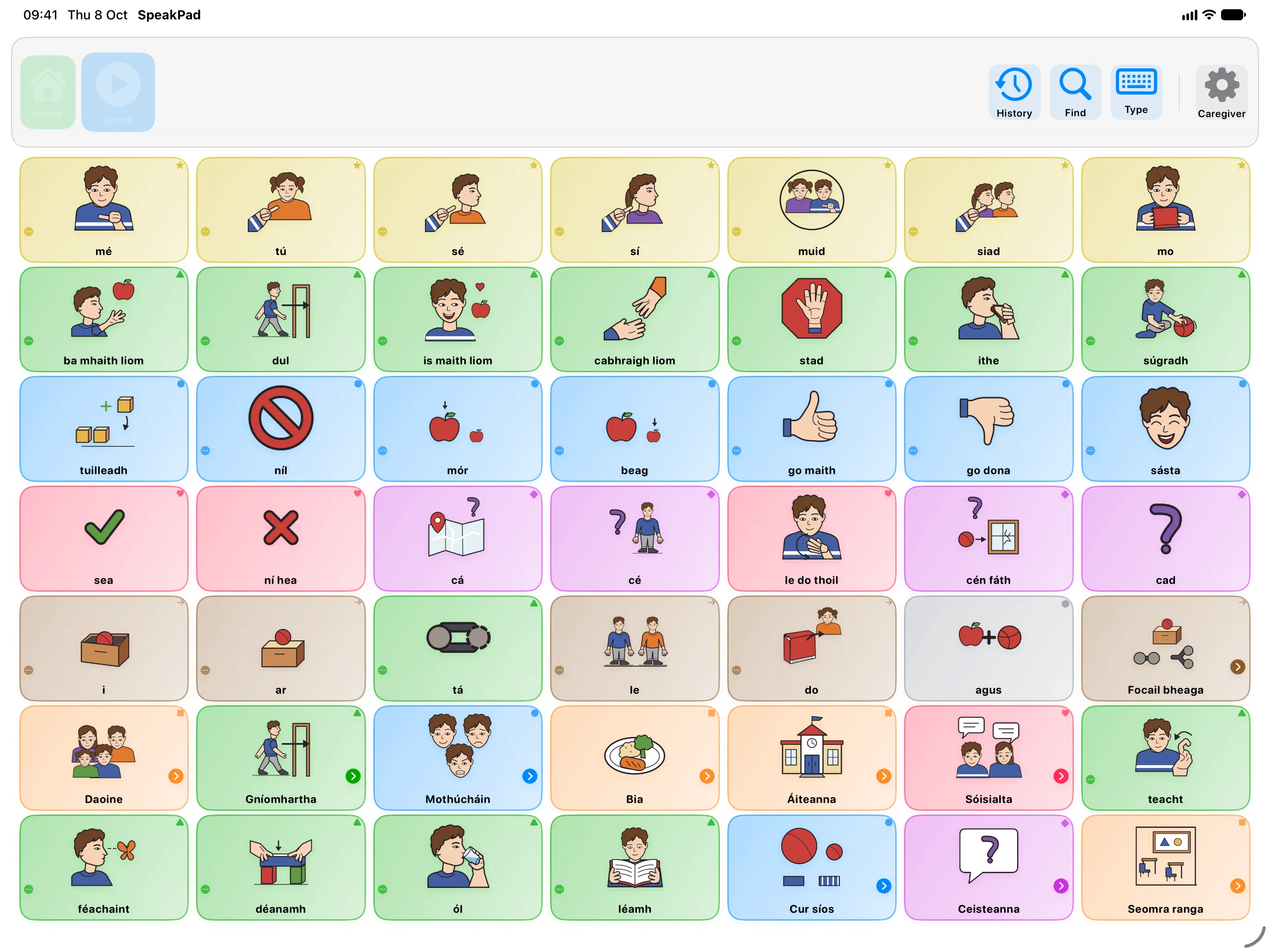
SpeakPad does not decide what counts as a word, so a button can hold anything: a single word, a five-word script, or a song line. The label and the spoken text can differ, letting a button read "outta here!" while speaking the full phrase exactly the way your child says it. Sentence history keeps the phrases they use most within easy reach, you can use photos from your own camera roll to anchor scripts to real moments, and buttons stay where you put them. It is free to download, so you can build a script-first board this afternoon and see how it lands.
A Board That Speaks Their Language
Private, offline AAC for iPhone and iPad. Speaking is always free, with optional SpeakPad Pro tools for caregivers.
Download on the App Store Learn More About SpeakPadSources
- Hutchins, T. L., Knox, S. E., & Fletcher, E. C. (2024). Natural language acquisition and gestalt language processing: a critical analysis of their application to autism and speech language therapy. Autism & Developmental Language Impairments, 9.