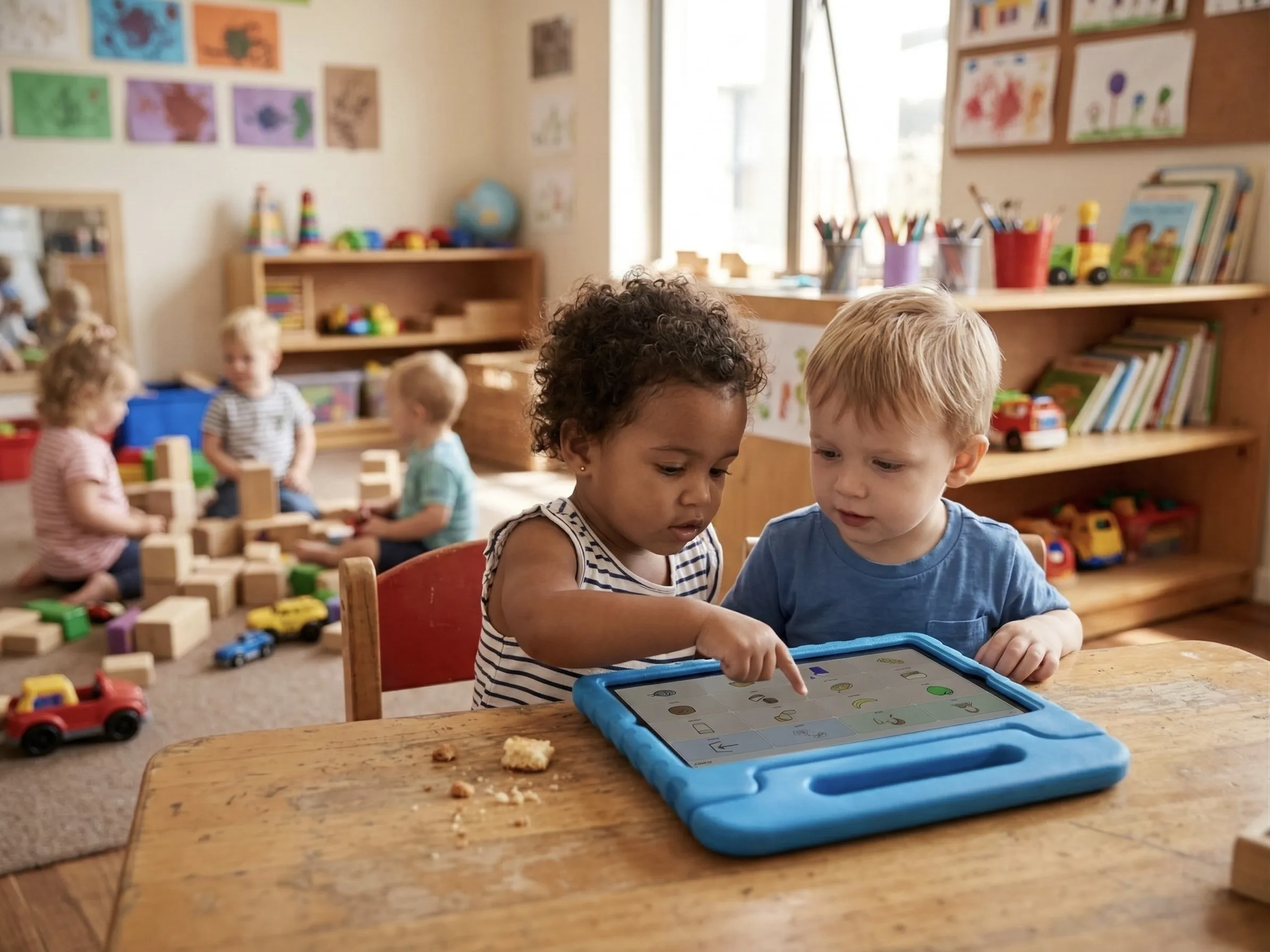
A full AAC app can cost $299.99. That's a lot to spend before you know whether your child will take to it, so it makes sense to start with a free one.
Not every "free" app stays free, though. Some stop speaking when a trial ends. So we checked the App Store listing or pricing page for every app below, and we've listed them all at the end so you can check them too.
Disclosure: we make SpeakPad, which is one of the apps listed.
What You Get Without Paying
These are US App Store prices. They vary by country and change over time.
| App | Free | Paid |
|---|---|---|
| SpeakPad | Speech, word prediction, switch scanning and board editing, with no time limit or ads | Optional Pro for caregivers: $5.99/month, $39.99/year or $119.99 once |
| Cboard | Basic boards and communication | Cboard Pro, $8/month or $79/year, adds ad-free use, recorded voices and board sharing |
| TD Snap | One month of speech | $9.99/month for speech |
| Proloquo | One-month trial | $9.99/month or $99.99/year |
| Avaz AAC | 14-day trial | $9.99/month, $99.99/year or a lifetime purchase |
| Proloquo2Go | No free trial listed | $249.99 once |
| TouchChat HD with WordPower | 30-day trial through TouchChat Discover, then basic lite-tech boards | $299.99 once |
| LAMP Words for Life | 30-day trial through LAMP Words for Life Discover, then a basic lite-tech board | $299.99 once |
What "Free" Should Mean
For AAC, free should mean your child can keep talking. There's no trial that runs out, and no ad in the middle of a sentence. An optional upgrade is fine, as long as your child's voice doesn't depend on it.
Ask three things. Does it still speak when the trial ends? Will my child see ads? What happens to our boards if we stop paying?
1. SpeakPad: Speaking Is Always Free
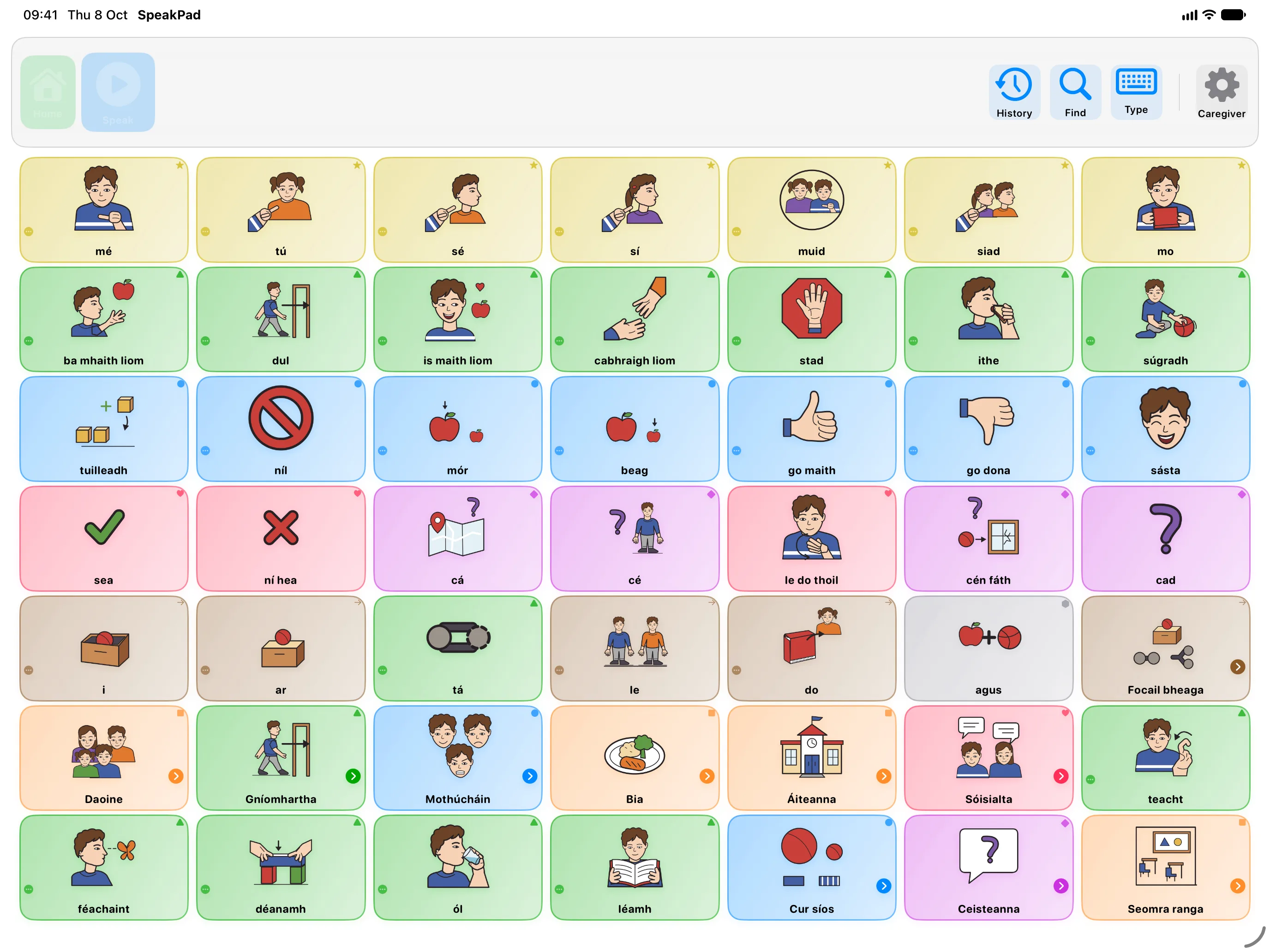
SpeakPad is designed by speech and language experts to help children communicate with pictures on iPhone and iPad. Pick a language and a starting set of words, and you're on a board that's ready to use. You don't need an account.
- Your child can always talk. Speech, sentence building and word prediction are free, with no time limit and no ads. If you try Pro and later stop paying, your child's boards keep working.
- Words stay where your child learned them. Adding words or opening up the next stage doesn't move anything. In one study, young children found pictures faster by their fifth session when the pictures stayed in the same places (Thistle and colleagues, 2018). Those children didn't have disabilities, so it's a guide rather than proof for every child.
- You can make it your child's own. Add your own words, use real photos of the dog, Nana or a favorite snack, and fix how a tricky name is said. That's all free.
- It works for children who can't tap easily. Switch scanning is free, and so is every other accessibility feature.
- It speaks nine languages. Boards and speech come in all of them, and bilingual mode shows two languages on every button.
- It grows with your child. Start with a few large buttons or a photo of your own kitchen with tap zones drawn on it. Move on to a full board, then a keyboard with word prediction.
The free version has three limits: two communicator profiles, one change of vocabulary set per profile, and 30 new symbols from the library on each profile. Your own words and photos don't count toward those.
SpeakPad Pro is optional, and it's for the adults who look after the boards. It adds things like natural-sounding English voices, building a whole board from a word list, PDF reports, goal tracking and sharing boards with a team. See what Pro includes.
Download on the App Store2. Cboard: Free Basics in Many Languages
Cboard is open source and says it supports 46 languages, so it's worth a look if SpeakPad doesn't have yours. It runs in a browser as well as an app, which helps on a shared computer.
The free tier is basic. Cboard's pricing page puts ad-free use, recording your own voice on a tile, copying tiles and sharing boards under Pro. You'll also want an account, because Cboard warns that changes may not save safely without one.
3. Paper Boards: Always Free
You don't have to choose between an app and paper. Printed communication boards are AAC too, and ASHA, the US professional body for speech-language pathologists (SLPs), says preferred practice combines different ways of communicating. A laminated board is there when the iPad's battery dies, at the pool, or when the screen cracks.
Paper can't speak, and it only holds so many words. It works best alongside an app. SpeakPad prints any board for free, and you can download these ones right now:
Free to Download, Then You Pay
TD Snap, Proloquo and Avaz AAC turn up in searches for free AAC apps because they cost nothing to download. All three are paid once the trial ends. TD Snap's listing says speech needs a monthly subscription after one month. Proloquo gives you one month, and Avaz gives you 14 days.
They're established systems, and paying can make sense when a school or funder covers it. For a family testing AAC at home, find out what happens to speech when the trial ends before you build your child's words into the app.
The Big One-Time Purchases
Proloquo2Go ($249.99), TouchChat HD with WordPower ($299.99) and LAMP Words for Life ($299.99) are long-running systems with deep vocabularies. Proloquo2Go lists no free trial. The other two offer 30 days through free Discover apps. Your child's therapist may recommend one of these, and that doesn't have to mean the cost falls on you.
Who Can Help Pay
- School, in the US: If a child needs assistive technology as part of their special education, the school must make it available. That can include use at home if the IEP team decides the child needs it (IDEA, 34 CFR 300.105).
- School, in England: A local authority must secure the special educational provision set out in an EHC plan (Children and Families Act 2014, section 42). Ask for any communication aid your child needs to be written in.
- NHS, in England: Most people are supported by local AAC services, and specialized services assess people with the most complex needs and can provide equipment (NHS England). Your speech and language therapist can tell you how to get referred.
- Insurance, in the US: Tablets and apps aren't treated like dedicated speech devices, and coverage varies by plan (ASHA). Ask an SLP to check yours.
- Device loans: US state assistive technology programs list contacts for device loans (AT3 Center). Elsewhere, ask your therapist what you can borrow and try.
The Bottom Line
Start free, and start now. ASHA says there are no prerequisites for AAC, so your child doesn't have to be "ready" first. What helps is adults using the board themselves while they talk. A review of the research found this kind of modeling highly effective across ages, disabilities and language skills (O'Neill and colleagues, 2018). And AAC doesn't get in the way of speech:
None of the 27 cases demonstrated decreases in speech production as a result of AAC intervention, 11% showed no change, and the majority (89%) demonstrated gains in speech.
SpeakPad gives you what you need to start modeling today, without paying anything. Involve a speech and language therapist as early as you can. They can check the fit and, if your child later needs a different system, plan the move so familiar words are easy to find again.
Want a board that speaks?
Private, offline AAC for iPhone and iPad. Speaking is always free, with optional SpeakPad Pro tools for caregivers.
Download on the App StoreSources
- Thistle, J. J., Holmes, S. A., Horn, M. M., & Reum, A. M. (2018). Consistent symbol location affects motor learning in preschoolers without disabilities: implications for designing augmentative and alternative communication displays. American Journal of Speech-Language Pathology, 27(3), 1010-1017.
- O'Neill, T., Light, J., & Pope, L. (2018). Effects of interventions that include aided augmentative and alternative communication input on the communication of individuals with complex communication needs: a meta-analysis. Journal of Speech, Language, and Hearing Research, 61(7), 1743-1765.
- Millar, D. C., Light, J. C., & Schlosser, R. W. (2006). The impact of augmentative and alternative communication intervention on the speech production of individuals with developmental disabilities: a research review. Journal of Speech, Language, and Hearing Research, 49(2), 248-264.
- American Speech-Language-Hearing Association (n.d.). Augmentative and Alternative Communication. ASHA Practice Portal.
- U.S. Department of Education (n.d.). 34 CFR § 300.105: Assistive technology. Individuals with Disabilities Education Act regulations, via Cornell Legal Information Institute.
- UK Parliament (2014). Children and Families Act 2014, section 42: Duty to secure special educational provision and health care provision in accordance with EHC Plan. legislation.gov.uk.
- NHS England (2016). Guidance for commissioning AAC services and equipment. NHS England.
- AT3 Center (n.d.). AT Act Programs. AT3 Center.
- SpeakPad (n.d.). SpeakPad AAC. US App Store listing, checked 4 November 2026.
- Cboard (n.d.). Cboard pricing. Cboard website, checked 4 November 2026.
- Cboard (n.d.). Cboard. Cboard website, checked 4 November 2026.
- Cboard (n.d.). AAC Cboard APP. US App Store listing, checked 4 November 2026.
- Tobii Dynavox (n.d.). TD Snap. US App Store listing, checked 4 November 2026.
- AssistiveWare (n.d.). Proloquo. US App Store listing, checked 4 November 2026.
- Avaz (n.d.). Avaz AAC. US App Store listing, checked 4 November 2026.
- AssistiveWare (n.d.). Proloquo2Go AAC. US App Store listing, checked 4 November 2026.
- PRC-Saltillo (n.d.). TouchChat Discover. US App Store listing, checked 4 November 2026.
- PRC-Saltillo (n.d.). LAMP Words For Life. US App Store listing, checked 4 November 2026.
- PRC-Saltillo (n.d.). LAMP Words For Life Discover. US App Store listing, checked 4 November 2026.