If your child has childhood apraxia of speech (CAS), you already know the heartache of watching them try to speak and not be understood. Apraxia is a motor speech disorder: the brain knows exactly what it wants to say, but struggles to plan and sequence the mouth movements to say it. The thoughts are there. The words get stuck on the way out.
AAC (Augmentative and Alternative Communication) gives those thoughts a reliable way out while speech is still developing. This guide explains why AAC helps children with apraxia, what the research says about speech, and how to choose an app that fits.

What is Childhood Apraxia of Speech?
CAS is not a delay in learning words, and it is not a hearing or muscle-weakness problem. It is a difficulty with motor planning: coordinating the precise, rapid movements of the lips, tongue, and jaw. A child with apraxia may say a word clearly one moment and be unable to repeat it the next. That inconsistency is a hallmark of apraxia, and it is exhausting for the child.
Will AAC Stop My Child From Talking?
This is the fear that stops many families, so let us be clear: the research does not support it. Studies consistently find that AAC does not hinder speech, and for many children it supports it. Each tap also gives your child a clear, consistent model of the word to hear. Therapy for apraxia is built on frequent, intensive practice of speech movements, and AAC works alongside that practice, not instead of it.
…augmentative and alternative communication (AAC) can provide functional communication that supports and enhances verbal speech production at the same time.
AAC is a ramp, not a replacement. It gives your child access to communication today, and it stays useful even as spoken words start to come. Reviews of the research have not found AAC reducing children's speech.
Why AAC Helps Children With Apraxia
- It removes the pressure. When talking is exhausting and unreliable, a symbol your child can always reach lowers the stakes of every interaction.
- It models word structure. Tapping symbols in order shows how words combine into phrases, building language even when the mouth cannot keep up.
- It reduces frustration. A child who can ask for what they need has far less reason to melt down over being misunderstood.
- It supports total communication. Speech, signs, gestures, and AAC can all coexist. The goal is being understood, by any means.
What to Look For in an AAC App for Apraxia
- Stable button positions. Words that stay in the same place let your child find them by habit, without searching each time.
- Strong core vocabulary. High-frequency words like more, stop, go, help, and want do the most work in daily talk.
- Room to grow. The app should expand from single words to phrases and sentences as your child progresses.
- Clear speech output. The spoken voice should be crisp, so it doubles as a model for speech practice.
- Low cost to start. Apraxia is a long road; you should not have to spend hundreds of dollars before you know an app fits.
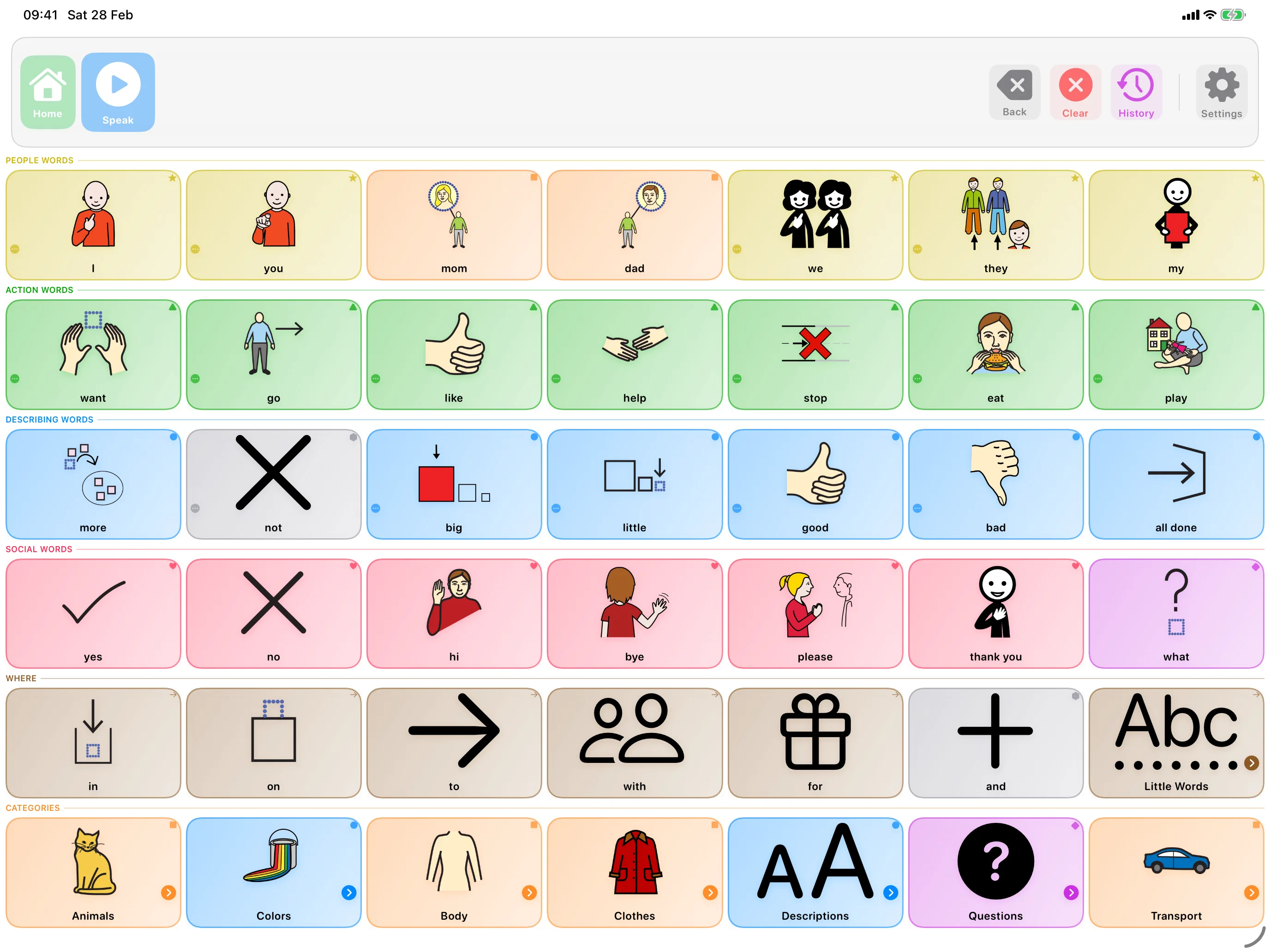
How SpeakPad Fits
SpeakPad was built for exactly this: early communicators who need consistent layouts and clear, spoken models. Word positions stay fixed, so your child can learn locations by muscle memory. Every tap is spoken aloud in a clear voice, single words grow into sentences, and there are 26,000+ symbols across 9 languages. It works fully offline, never sends your child's words to us, and is free to download, so you can start modeling today and let your speech-language therapist guide the rest.
Getting Started
- Model without pressure. Use the app yourself as you talk, and never turn it into a quiz.
- Pair it with your therapist. A speech-language therapist can align the app's vocabulary with your child's speech targets.
- Keep it available everywhere. Home, school, the car, grandparents' house: communication should never be out of reach.
- Celebrate every attempt. A tap, a sound, a spoken word: each one is communication, and each one counts.
Give Their Words a Way Out
Private, offline AAC for iPhone and iPad. Speaking is always free, with optional SpeakPad Pro tools for caregivers.
Download on the App Store Learn More About SpeakPadSources
- American Speech-Language-Hearing Association (n.d.). Childhood Apraxia of Speech. ASHA Practice Portal.
- Millar, D. C., Light, J. C., & Schlosser, R. W. (2006). The impact of augmentative and alternative communication intervention on the speech production of individuals with developmental disabilities: a research review. Journal of Speech, Language, and Hearing Research, 49(2), 248-264.
- Oommen, E. R., & McCarthy, J. W. (2015). Simultaneous natural speech and AAC interventions for children with childhood apraxia of speech: lessons from a speech-language pathologist focus group. Augmentative and Alternative Communication, 31(1), 63-76.